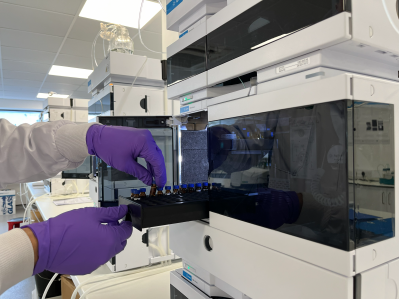
What is HPLC?
High-performance liquid chromatography (HPLC) is a modern analytical method that enables the precise separation, identification, and quantification of individual components in a liquid mixture. It is one of the most important techniques in analytical chemistry and is used wherever non-volatile, thermally labile, or complex substances need to be analyzed—for example, in food, cosmetics, pharmaceutical, or environmental analysis.
Unlike gas-based separation methods, HPLC uses a liquid mobile phase that is pumped through a separation column under high pressure. Inside the column, the sample's molecules interact with the stationary phase, resulting in a time-dependent separation of the individual analytes. The outcome is a chromatogram that shows both the identity and the amount of the compounds present.
Advantages of HPLC
HPLC has several characteristics that make it indispensable in modern analytical chemistry.
- Versatility: Analysis of non-volatile and thermally unstable substances that cannot, or can only with difficulty, be analyzed using gas chromatography
- High separation efficiency: Precise separation even of structurally similar compounds
- Speed: Run times are often on the order of a few minutes
- Sensitivity: Very low concentrations can be detected reliably
- Flexibility: By choosing suitable columns, eluents, and phases, the method can be adapted to almost any analytical question
- Combinability: HPLC can easily be coupled with other analytical techniques, such as mass spectrometry (HPLC-MS), which enables unambiguous structural elucidation and very low detection limits
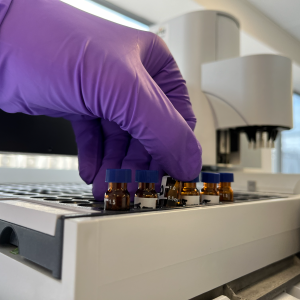
How does HPLC work?
In HPLC, the sample passes through several clearly defined steps that must all be precisely coordinated in order to obtain reproducible and meaningful results.
First, the sample is prepared. Depending on the matrix, this may mean filtering, diluting or concentrating it. Contaminants that could damage the column or distort the analysis are removed.
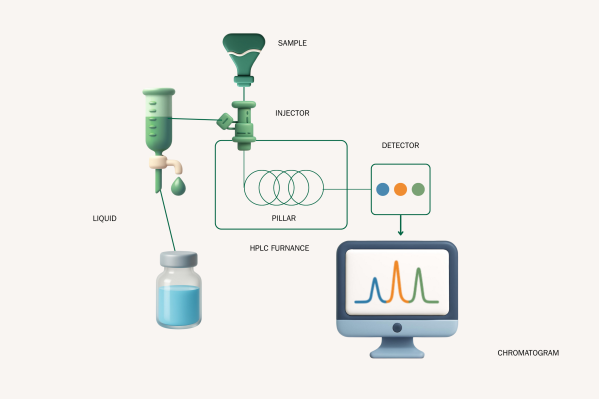
The prepared sample is then introduced into the continuous flow of the mobile phase (eluent) by means of an injector. This eluent is delivered through the stationary phase inside the column by one or more pumps at high pressure, typically between 50 and 400 bar.
The stationary phase is bound to a solid support material (for example, silica gel). Depending on the composition and surface chemistry of this phase, specific interactions occur with the analytes, for example, based on their polarity, size, or chemical structure. Substances that interact more strongly with the stationary phase move more slowly through the column, while molecules with lower affinity are transported faster.
These different retention times ensure that the substances appear at the column outlet separated in time. A detector records the arrival of each substance and converts it into an electrical signal, which is displayed as a peak in the chromatogram.
Components of an HPLC system
An HPLC system is modular and can be adapted to the properties of the mixtures to be analyzed.
Pump: Ensures the continuous flow of the mobile phase through the column and must deliver constant pressure to guarantee reproducible retention times
Injector: Introduces a precisely defined volume of sample into the system without interrupting the flow
Column: Filled with a fine, porous material whose surface is coated with the stationary phase. The selection of the column (length, internal diameter, particle size and type of stationary phase) is crucial for the quality of the separation
Detector: Detects the analytes as they leave the column. UV/VIS detectors are most commonly used, but fluorescence, refractive index or mass spectrometric detectors are also employed
Data processing unit: Displays the detector signals as a chromatogram. Evaluation is carried out using software
Phases in HPLC and their differences
High-performance liquid chromatography separates mixtures based on the different interactions of the analytes with two phases. The mobile phase (eluent) and the stationary phase (material inside the column).
The strength of interaction between a molecule and the stationary phase largely determines its retention time, that is, the time it needs to pass through the column. Careful selection and tuning of these phases is crucial for the quality and significance of an analysis.
The mobile phase: the Eluent
The mobile phase is a liquid that transports the dissolved sample through the column. It usually consists of water and organic solvents such as methanol, acetonitrile or isopropanol. The choice of components and their mixing ratio is matched to the chemical properties of the substances to be separated.
Important influencing factors:
- Polarity of the eluent: Determines how strongly polar or non-polar molecules interact with the stationary phase
- pH value: Especially important for ionizable compounds, it influences their charge state and therefore their interactions
- Additives: Buffers, salts or modifiers can improve separation, optimize peak shape or stabilize a particular ionization state
In isocratic elution, the composition of the eluent remains constant throughout the analysis. This is suitable for relatively simple separations with similar retention times.
In gradient elution, the composition of the eluent changes during the run, for example, through an increasing proportion of organic solvent. This allows strongly retained analytes to be eluted more quickly and complex mixtures to be separated more efficiently.
The mobile phase must be of high purity (HPLC grade) so that it does not generate interfering signals in the chromatogram.
The stationary phase: inside of the column
The stationary phase is the material inside the column that actually causes the separation. It usually consists of fine silica particles with a precisely defined particle size, typically 3–5 µm, in UHPLC even less than 2 µm. The surface is chemically modified to enable specific interactions with the analytes.
Main types of stationary phases in HPLC:
- Normal phase: Polar-coated silica. Separates molecules according to polarity. Polar analytes are retained longer, non-polar ones elute more quickly
- Reversed phase: Non-polar coating (for example, C18, C8 or phenyl groups). The mobile phase is polar, so non-polar substances remain longer in the column. This mode is the most commonly used today
- Ion exchange chromatography: The surface carries charged groups that interact with oppositely charged analytes
- Size exclusion chromatography (SEC): Separates according to molecular size. Large molecules pass through the column faster, and smaller ones enter the pores and are delayed
Influence of length, diameter and particle size
Physical parameters of the column that influence separation performance:
- Column length: Longer columns improve resolution but increase analysis time
- Internal diameter (ID): Smaller diameters provide sharper peaks but require more precise control of flow rate
- Particle size: Smaller particles increase surface area and improve separation, but result in higher backpressure
- Pore size: Especially relevant for the separation of large molecules such as proteins
Interaction of the mobile and stationary phases
The central principle of HPLC is partition chromatography. The analytes distribute themselves in an equilibrium between the mobile and stationary phases. The stronger a molecule interacts with the stationary phase, for example, through hydrophobicity, polarity, ionic interactions or Van der Waals forces, the longer it remains in the column.
Optimal separation is achieved when mobile and stationary phases are tuned in such a way that the differences in interaction behavior of the individual substances are maximized. Parameters such as flow rate, temperature and eluent composition must be adjusted precisely.
Detectors in HPLC
Detectors are essential to make the separated substances visible.
The UV/VIS detector measures the light absorption of eluting substances at specific wavelengths and can be used for many organic molecules. The fluorescence detector offers even higher sensitivity for fluorescent substances, while the refractive index detector (RI) can detect compounds that do not absorb UV light.
For maximum specificity, HPLC is often coupled with a mass spectrometer. This HPLC-MS combination enables unambiguous identification and structural elucidation of unknown compounds, even in complex matrices.
Evaluating HPLC analyses using chromatograms
The chromatogram is the central result of an HPLC analysis. Time is shown on the x-axis, detector signal intensity on the y-axis. Each peak represents a single substance.
The retention time is characteristic of a particular analyte and describes the time a molecule needs to travel through the column. Together with reference standards, it allows identification of molecules. The same retention time as the standard indicates the same molecule. Molecules can only be identified in relation to a standard.
The height or area of the peak is proportional to the concentration of the substance. Symmetrical peak shape is important for accurate analysis. Asymmetrical or overlapping peaks can indicate insufficient separation, overloading or problems with the column.
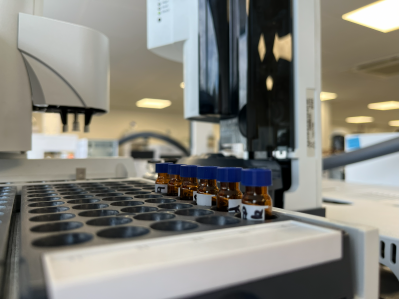
Fields of application in analytics
HPLC is a universally applicable analytical method with a wide range of uses.
Qualitative analyses serve to identify the components of a sample. Examples include detection of pesticide residues in food, authenticity testing of natural products such as essential oils or identification of preservatives in cosmetics.
Quantitative analyses determine the exact content of a substance. Typical applications include determining the content of vitamins and sweeteners in foods, measuring active ingredient content in pharmaceutical products or analyzing additives in beverages.
By coupling HPLC with mass spectrometry, unknown substances in complex matrices can also be clearly identified.
HPLC at Tentamus: precision through many years of expertise
Our laboratories within the international Tentamus network work with state-of-the-art HPLC and UHPLC systems to analyze your samples precisely and reliably. We offer both qualitative and quantitative analyses and develop a customized method for each analytical question.
In addition to performing the analyses, we support you in selecting the appropriate column, optimizing eluent composition and evaluating the results. Our laboratories are accredited according to DIN EN ISO/IEC 17025 and meet the highest quality standards.
Our expert teams support you with:
- Selection of suitable methods for your HPLC analysis
- Performance of qualitative and quantitative analyses
- Residue analysis, authenticity testing and composition
- Validation and documentation for regulatory requirements
Would you like to learn more about our high-performance liquid chromatography services or request an analysis?
FAQ: Frequently asked questions about HPLC
How long does an HPLC run take?
Depending on the method, the actual analysis takes between a few minutes and about one hour. Gradient methods generally require more time than isocratic ones. However, results are not available immediately. Time for sample registration, sample preparation and evaluation also has to be considered.
What is the difference between HPLC and LC?
LC (liquid chromatography) is the umbrella term for all liquid chromatography methods. HPLC is a specific form of LC that uses high pressure and fine column material to achieve higher separation performance. As a result, HPLC offers faster, more precise and more reproducible analyses than classical LC.
What is UHPLC?
Ultra-high performance liquid chromatography (UHPLC) is used when very high resolution and very short analysis times are required. By using smaller particles (less than 2 µm) and higher pressure, it separates even very similar substances more cleanly than conventional HPLC. It is particularly suitable for complex samples, small sample volumes and time-critical analyses.
When is HPLC used, and when GC?
HPLC is ideal for non-volatile, thermally unstable or high-molecular compounds. GC is used for volatile and thermally stable substances.
Why is HPLC often coupled with MS?
Coupling with mass spectrometry enables unambiguous identification of unknown mixtures. HPLC first separates the mixture into fractions of the individual components. In the connected mass spectrometer, these pure but unknown fractions can then be identified.
What is SEC-HPLC?
SEC-HPLC (size exclusion chromatography) is a form of HPLC in which molecules are separated by size. Large molecules pass through the pores of the stationary phase more quickly, smaller ones penetrate deeper and are delayed. It is often used to analyze proteins, enzymes or polymers.
How much does an HPLC analysis cost?
The costs depend on the depth of analysis, the sample matrix and the detection method used.
What is the difference between an internal and an external standard?
An internal standard is added directly to the sample. An external standard is measured separately. Both are used to quantify the components of the mixture to be analyzed.
Which factors influence separation performance in HPLC?
Separation performance is mainly influenced by the choice of the stationary phase (chemistry, particle size, column length, pore size) and mobile phase (composition, polarity, pH value). Flow rate, temperature, and elution mode (isocratic or gradient) also play an important role. For optimal results, all parameters must be matched to the chemical properties of the analytes.
What is the capacity factor in HPLC?
The capacity factor (also called retention factor, k) is an important parameter in HPLC that describes how long an analyte remains in the stationary phase relative to the mobile phase. It is calculated from the difference between the retention time of the analyte (tR) and the dead time (t0, the time of substances not retained by the column), divided by t0.
A high capacity factor indicates that the analyte interacts with the stationary phase for an extended period. A low value indicates fast elution. Optimal values usually lie between 1 and 10. Values that are too small indicate insufficient separation, values that are too large indicate very long analysis times.
The capacity factor is independent of flow rate, so it is a stable parameter for method development and comparison of analyses. It plays a central role in optimizing separation performance and run time in HPLC.
This may also interest you
- Gaschromatographie (GC)
- GC-MS
- LC-GC